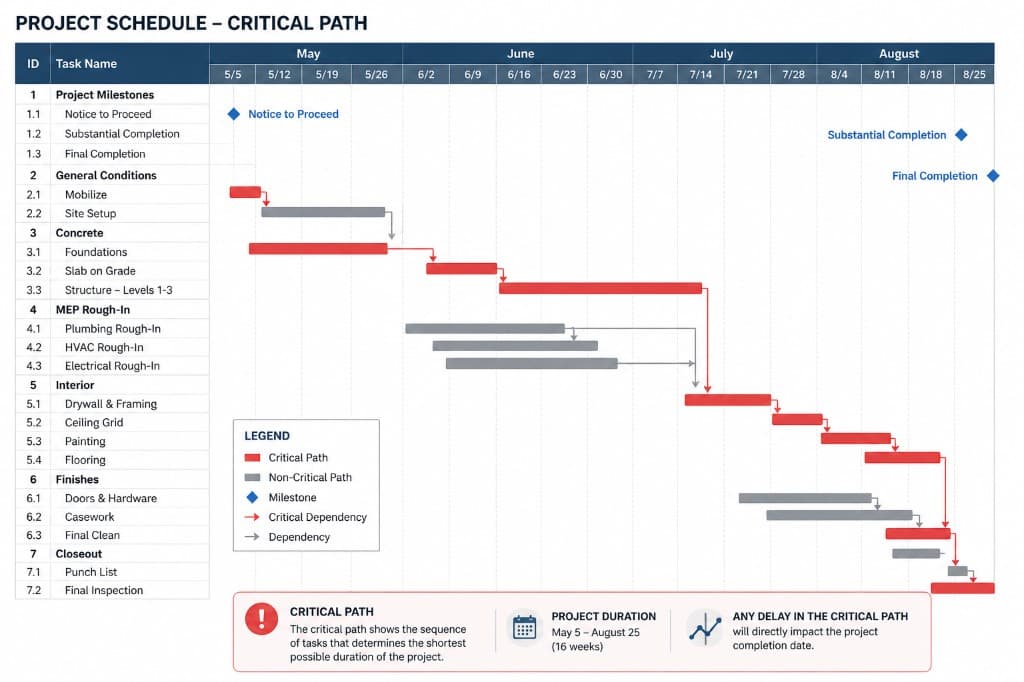
Schedule Slips Aren't Single Events
A late RFI on Monday. A sub two days behind on Tuesday. A coordination miss that gets noticed Friday but doesn't surface in writing until the following Wednesday. By the time anyone uses the word "delay" out loud, you've already been delayed for two weeks.
The research on this is consistent enough to take seriously. Planning failures and subcontractor coordination problems drive the largest share of time overruns. Three categories—execution problems, administrative issues, and labor conflicts—account for roughly 80% of delay causes across projects. Rework runs 12–15% of total project costs. Out-of-sequence work hits about 15% of project activities, and each 5% increase in out-of-sequence activity correlates with an 8.5% productivity drop, a 10% cost increase, and an 11% schedule extension.
These aren't outlier numbers. They're average outcomes on jobs that aren't actively defending against them. The defense is front-end planning—trade coordination, lookaheads, sequence resolution, RFI aging. All the things that don't feel urgent until they are.
What AI Can and Can't Do Here
AI will not fix your schedule. It will not resolve trade conflicts. It will not make a subcontractor show up.
Most delays don't happen because nobody knew something was slipping. They happen because nobody connected the dots early enough—an open RFI sitting twelve days while a dependent activity is two weeks out, a trade overlap that showed up in the drawings but never got flagged in the coordination meeting. The value AI brings is catching those connections earlier, before they require a Friday afternoon phone call to fix.
That's a narrower claim than most people make about automation, but it's the honest one.
Analyzing a Schedule Before Problems Show Up
Most schedules get updated but not actively analyzed. They sit until someone needs to explain why something is late, at which point the question becomes forensic rather than preventive.
You can take a schedule export—Primavera, MS Project, even Excel—and use AI to look for risk patterns before they reach the field:
This isn't replacing scheduling software. It's forcing a structured review that most teams skip because nobody has time to sit with the schedule long enough to think through the dependencies.
Turning Risk Into Follow-Up
Identifying risk is only useful if something happens after. Most jobs already have a general sense of where the problems are—what's missing is consistent follow-up before those problems compound.
Once risks are identified, the next step is generating structured action:
That turns a passive schedule review into a list of things that actually get sent.
Connecting RFIs to the Schedule
This is one of the more consistent gaps on active jobs: RFIs get tracked, schedules get tracked, and the two lists never talk to each other. An RFI sits at day eleven and nobody has checked whether the activity it affects is starting in eight days.
A simple prompt bridges that:
Running this before the weekly coordination meeting changes what gets discussed. Instead of "anything we need to cover?"—which produces a rambling list—you walk in knowing that the electrical and mechanical overlap in Area B needs a decision before Thursday.
Weekly Lookahead Prep
The same logic applies to lookahead preparation. Before the coordination meeting, run the schedule through an AI analysis, pull the top risks, generate the follow-up items, and walk in with the agenda already built. The meeting becomes a confirmation of decisions rather than a discovery session—which is what lookaheads are supposed to be and rarely are.
Finding Patterns in Rework
Most teams log rework in some form but never go back to look at it. The event gets dealt with, the cost gets absorbed, and the same coordination failure shows up three weeks later on a different trade.
Structuring rework data and running it through a pattern analysis changes that:
The goal isn't a root cause report for its own sake. It's catching a repeating problem before it runs through the rest of the schedule.
Prefab Decisions
Prefab evaluations tend to get oversimplified—field labor versus shop labor, and not much else. That comparison ignores rework risk, coordination density, sequence compression, and access constraints, all of which can swing the decision significantly.
A more complete analysis:
This doesn't make the call for you. It makes sure the call gets made with the right variables on the table.
What Doesn't Change
Lookaheads still matter. Trade coordination still matters. Phone calls still matter. The mechanical and electrical subs are not going to resolve a conflict because a risk report flagged it—the PM still has to get them in the same room.
The tool surfaces the issue. Someone still has to resolve it. That distinction matters because the teams that get the most out of these workflows are the ones who are already running tight coordination and want to catch things earlier—not teams hoping automation will replace the management work.
The Actual Advantage
Most project teams are already doing the right things. Running lookaheads, tracking RFIs, updating schedules, managing subs. The gap isn't knowledge of what to do—it's consistency. These processes work when they're done well every week, and they break down when someone's busy, traveling, or managing three things at once.
What AI adds to a well-run project is consistency on the things that tend to slip—risk visibility, follow-up cadence, meeting preparation, early identification of compounding problems. The firms that use it well won't look dramatically different from the outside. They'll just catch issues a little earlier, follow up a little more reliably, and recover faster when something goes sideways.
Schedule slips are a series of small misses that stack. Most of them are visible before they become expensive. The question is whether anyone's looking early enough to do something about it.