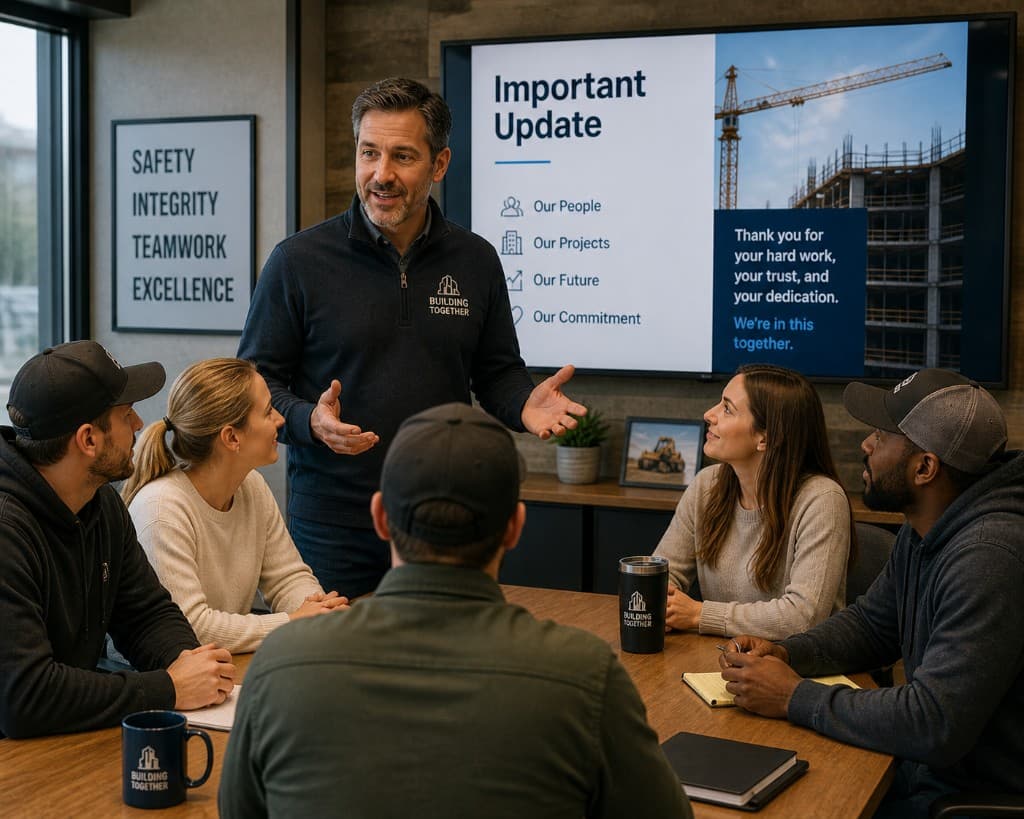
The story your team is telling themselves about automation right now is worse than whatever you're planning to actually do.
The estimator thinks their job is in jeopardy because their cousin who works in marketing got laid off when their firm rolled out an AI tool. The PE who's two years out of school thinks they're going to be the first cut because they're junior. The super thinks the company is going to make them carry an iPad with eighteen new apps on it.
Nobody on your team is sleeping well. Everyone has heard a story. The longer you don't say anything, the longer the worst story is the one they're working with.
That's the problem you're solving when you talk to the team about AI. Not the technology. The narrative.
Be Direct or Don't Bother
The team already senses the shift. Owners are asking about precon faster. GCs want digital submittals. The competing firm two states over just announced an AI initiative on LinkedIn.
The wrong move is corporate language. "We're embarking on a digital transformation journey." Nobody believes that sentence. Nobody is reassured by it.
The right move sounds like this:
"Automation is the next phase of construction. We're not adopting it because it's trendy. We're adopting it because every firm we compete with is. Our goal isn't to replace people. Our goal is to remove the work that drains our team and put their time on the work that wins us jobs."
That sentence is direct. It's honest. It tells the team what's happening, why, and what role they have in it. They don't need a deck. They need clarity from the operator.
What Falls Apart When You Don't Talk About It
The team starts hiding their AI use. The PE who's been quietly using a model to clean up their daily reports won't tell you because they're not sure if it's allowed. The estimator who's experimenting with a clarifications draft won't share it because they think it might be the wrong move politically.
You lose the institutional learning that should be happening in the open. You also lose the chance to set guardrails on the data, the accuracy, and the accountability—because the experimentation you don't know about is the experimentation you can't shape.
When you don't talk about it, the team uses it anyway. Just worse, more cautiously, and without the rest of the firm benefiting.
Be Specific About What's Going Away
The fastest way to ease fear is specificity. Not "we'll automate routine tasks." That sentence is meaningless and terrifying.
Instead: manual data entry into spreadsheets, rebuilding bid tabs from scratch, sorting emails for ITBs and submittals, typing the same response email twelve times a week, drafting OAC minutes from scratch, copy-pasting spec sections, retyping submittal logs into your format, rebuilding the same status report every Friday.
Read that out loud at the team meeting. Watch the room. The PE exhales. The estimator nods. The super smiles for the first time in the conversation. They've been doing those tasks for years and didn't realize the company was prepared to take them off the plate.
Now follow with:
"We're automating tasks. We're not automating roles. We want our people walking jobs, coordinating subs, talking to owners, and leading their teams. Not retyping logs."
Be Specific About What Becomes More Valuable
The flip side of the conversation. What grows.
Clear, concise digital communication—AI is good at clarity, and so are good PMs. Teach the team to write tighter emails, sharper RFIs, cleaner daily logs. The skill compounds.
Curiosity and experimentation—your best people are going to try things. Reward that. Even when it doesn't pan out. The team that learns by trying is the team that adapts when the tools change again next year.
System-first thinking—the people who ask "can we do this once and then automate it forever?" become more valuable. Not because they're more technical. Because they design work that scales.
Judgment—AI generates options. People still pick. The PE who's good at choosing among twelve drafted clarifications becomes more valuable, not less, in an automated firm.
Give Them a Hand in Designing It
Top-down automation gets resented. Automation that the team helped design gets adopted.
At the next team meeting, ask four questions:
What slows you down most? What do you copy-paste every week? Which tasks do you dread? If we could erase one part of your day, what would it be?
Write down the answers. Build the first three automations off that list, not off the consultant's list. The PE who told you their daily report eats forty-five minutes a day will be the first one to use the tool that makes it twenty minutes.
The opposite framing kills the project. "IT and ops have selected the following workflow for automation in Q2." That email gets read once, ignored, and the rollout dies in onboarding.
The Closing Line, And Why It Matters
The team needs a clean ending. Not a slogan. A position.
"Automation doesn't end the work we know. It changes the parts of it we hate doing. Our people are still our advantage. Automation just gives each person more time to use what makes them good at the job."
That's the message. Direct. Honest. Forward-facing. The team leaves the room with a story that's better than the one they came in with.
That's the entire purpose of the conversation.